
How Arrest Warrants Work in West Baton Rouge Parish
An arrest warrant is a judge's order to take a person into custody. West Baton Rouge Parish gets its warrants from a judge or magistrate after a probable-cause finding, and Louisiana Code of Criminal Procedure article 202 governs the complaint behind that finding while article 203 governs the warrant itself. Where the case goes depends on the charge. A felony or ordinary state matter lands in the 18th Judicial District Court, with the Clerk of Court keeping the file. City ordinance and traffic cases stay with Port Allen City Court or a Mayor's Court. Federal charges belong to the Middle District of Louisiana. A warrant is simply a step in a case that has not been resolved.
Where Probable Cause Enters the Process
Probable cause is the hinge of the whole process. A complaint or affidavit must lay out the nature, date, and place of the offense, plus the accused's name if it is known. The magistrate reads it and decides whether the facts justify an arrest. But there are other routes to a warrant. Article 496 allows one after an indictment, or after an information backed by affidavits that establish probable cause, unless the court issues a summons instead. Article 230.2 sets the timing for a probable-cause determination when someone was arrested without a warrant. That is why one case can produce several documents that look alike. A charging instrument, a sworn affidavit, and a warrant each do different work. The West Baton Rouge Parish clerk can tell you which one is actually on file.
Note: The affidavit supports the warrant but is not the signed warrant, so ask for the exact document you need.
Arrest Warrants: What They Contain
State law fixes what a warrant must contain. A West Baton Rouge Parish file usually adds the court's own case number too. These are the fields worth writing down.
| Heading | The warrant is written in the name of the state rather than in the name of a local agency. |
|---|---|
| Date of issuance | When the magistrate signed it, useful when comparing a recall or service entry. |
| Parish or municipality | Where it was issued, which tells you which court and agency hold it. |
| Name or description | The person to be arrested, named when known or described when not. |
| Offense charged | The charge the affidavit supports, taken from the complaint. |
| Command to arrest and book | The instruction authorizing custody and booking. |
| Magistrate signature | The signature that gives the document its authority. |
| Bail notation | An arrest warrant may state bail in a noncapital case. A printed figure is not a release decision. |
One number matters most. The case or docket number appears on the court's copy rather than in the statutory list, and every West Baton Rouge Parish office will ask for it first.
An Arrest Warrant Is Not a Search Warrant
The names sound alike, but the documents do different jobs. A search warrant covers property and evidence; it authorizes a search, not an arrest. Louisiana Code of Criminal Procedure article 161 governs how one is issued, and article 163 sets the rules for executing it. A search warrant file often ties into an open investigation, so a records request for it can be limited under the law enforcement exception in the public records statute. Do not bring a search warrant question to the arrest-warrant desk in West Baton Rouge Parish. The Warrant Division will not release investigative material just because both papers carry the word warrant.
How Warrants Get Served in West Baton Rouge Parish
Signing a warrant and serving it are separate events, which is why one can sit active while nothing appears to happen. The judge signs first. The clerk files the paper. Then it goes to an agency to serve. In West Baton Rouge Parish, deputies handle parish and district warrants, city police serve city warrants, and constables carry process from the justice of the peace courts. A warrant forwarded from another agency is administered here too. The sheriff describes its Warrant Division as a central repository for arrest documents, so it is the natural place to ask about status. Ask two questions when you call. Has this office received the paper, and is it still in the service queue? Then ask whether the court has acted in some way the sheriff's record has not caught up with yet.
The Warrant Division's Repository Role
The Warrant Division page spells out the unit's scope in plain terms. It administers arrest warrants for non-support, bench warrants, criminal warrants issued in West Baton Rouge Parish, and warrants forwarded by other agencies, keeping all those arrest documents in one place. Lieutenant Jessie Martinez is listed at 225-389-2309. That scope also explains a limit. The division holds only what has been sent to it, and a warrant that never left a city court never reaches the parish queue.
West Baton Rouge Parish Sheriff's Warrant Division
850 8th Street
Port Allen, LA 70767
225-389-2309
Ask before you drive over. Can the West Baton Rouge Parish office confirm your own status by phone, or does it want you in person? The public pages state no warrant-counter identification rule, so call first.
Arrest Warrants, Summonses, and Bench Warrants
Three documents can all bring a person before a West Baton Rouge Parish court, and each arrives for a different reason.
| Point | Arrest warrant | Summons | Bench warrant |
|---|---|---|---|
| What starts it | A complaint or affidavit reviewed for probable cause | A charging decision where the court expects an appearance | A missed obligation in a case that already exists |
| Custody at issue | Yes, it commands arrest and booking | No, it commands appearance | Yes, it brings the person before the court |
| Who issues it | A judge or magistrate | The court handling the charge | The judge who set the missed obligation |
| Typical local holder | District court record and the sheriff repository | The issuing court | The issuing court, then the serving agency |
A summons can turn into a warrant when circumstances change. So an old letter is not proof that no West Baton Rouge Parish warrant exists.
If the Arrest Happened Without a Warrant
Not every custody starts with paper. A person can be arrested first, and a West Baton Rouge Parish magistrate then makes the probable-cause decision within the time state law allows.
- Ask the booking desk which court holds the case and what the next court event is.
- Ask whether a probable-cause determination or a first appearance is already calendared.
- Ask what bond or release process applies, and who sets it.
- Contact counsel or the Public Defender about the case rather than negotiating at a counter.
- Once an action is taken, ask the court for a minute entry or order.
The Detention Center at 1150 Northwest Drive books a mixed population: pretrial, post-trial, federal, and state detainees. Custody alone never tells you which court to call. Its printed booking-desk hours run Monday through Friday, 8:00 a.m. to 4:30 p.m. The West Baton Rouge Parish sheriff directory, though, describes a desk open around the clock.
Handling an Arrest Warrant in Your Name
West Baton Rouge Parish gives you a few honest ways to deal with a warrant in your own name, and the right one turns on the charge and the court that issued it. A lawyer should shape the plan. The public record points to four routes: show up on a set date, have counsel file a motion, work out a payment plan the court orders, or post bond. Each route answers a different piece of the case, so pick with care. Bond needs its own explanation here. It settles the custody question alone, while the charge itself stays open along with any future court date. Before you leave, confirm the warrant was actually recalled, ask whether a new appearance has been calendared, and check whether a separate obligation still hangs on. Money tight? The parish directory lists the Public Defender at 750 Louisiana Avenue in Port Allen, reachable at 225-387-6209, and that office decides who qualifies. The home page's parish warrant overview pulls these same resolution steps together in one place.
Important: Talk with a lawyer before turning yourself in, because an unscheduled walk-in surrender is not a standard local procedure.
Can PACER Answer a Louisiana Warrant Question?
Only if you are asking about a federal case. West Baton Rouge Parish falls inside the Middle District of Louisiana, whose courthouse stands at 777 Florida Street in Baton Rouge. The federal clerk answers the phone at 225-389-3500 and keeps weekday hours of 8:00 a.m. to noon and 1:00 to 4:30 p.m. The PACER system stores federal district, bankruptcy, and appellate case records. Pricing runs $0.10 per page, capped at $3 per document, with quarterly waivers when charges stay at or below the threshold. One wall stands firm: sealed material, sealed indictments included, stays out of public view.
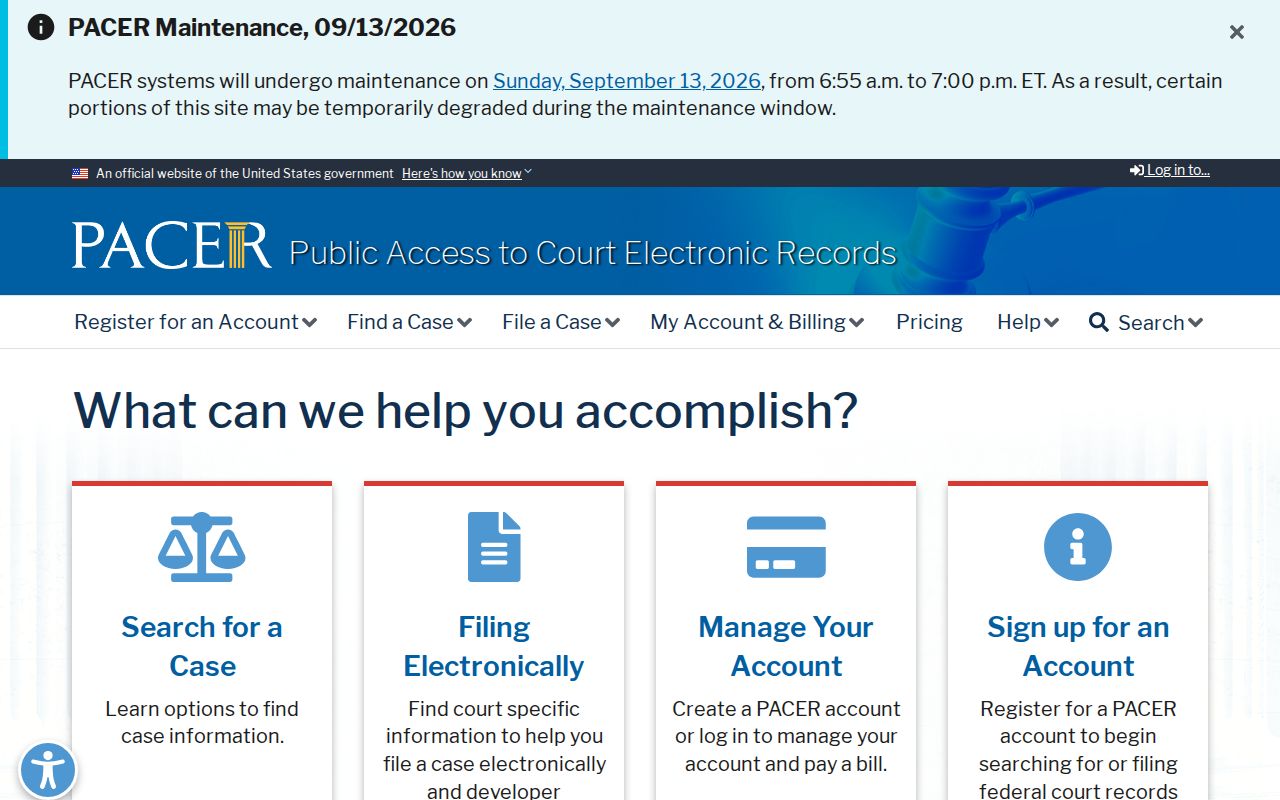
A PACER search that comes up empty proves nothing about a West Baton Rouge Parish state or city warrant. A sealed federal warrant never shows at all.
Note: Use the federal system only for federal cases, and route a state or municipal question back to the court that issued it.